
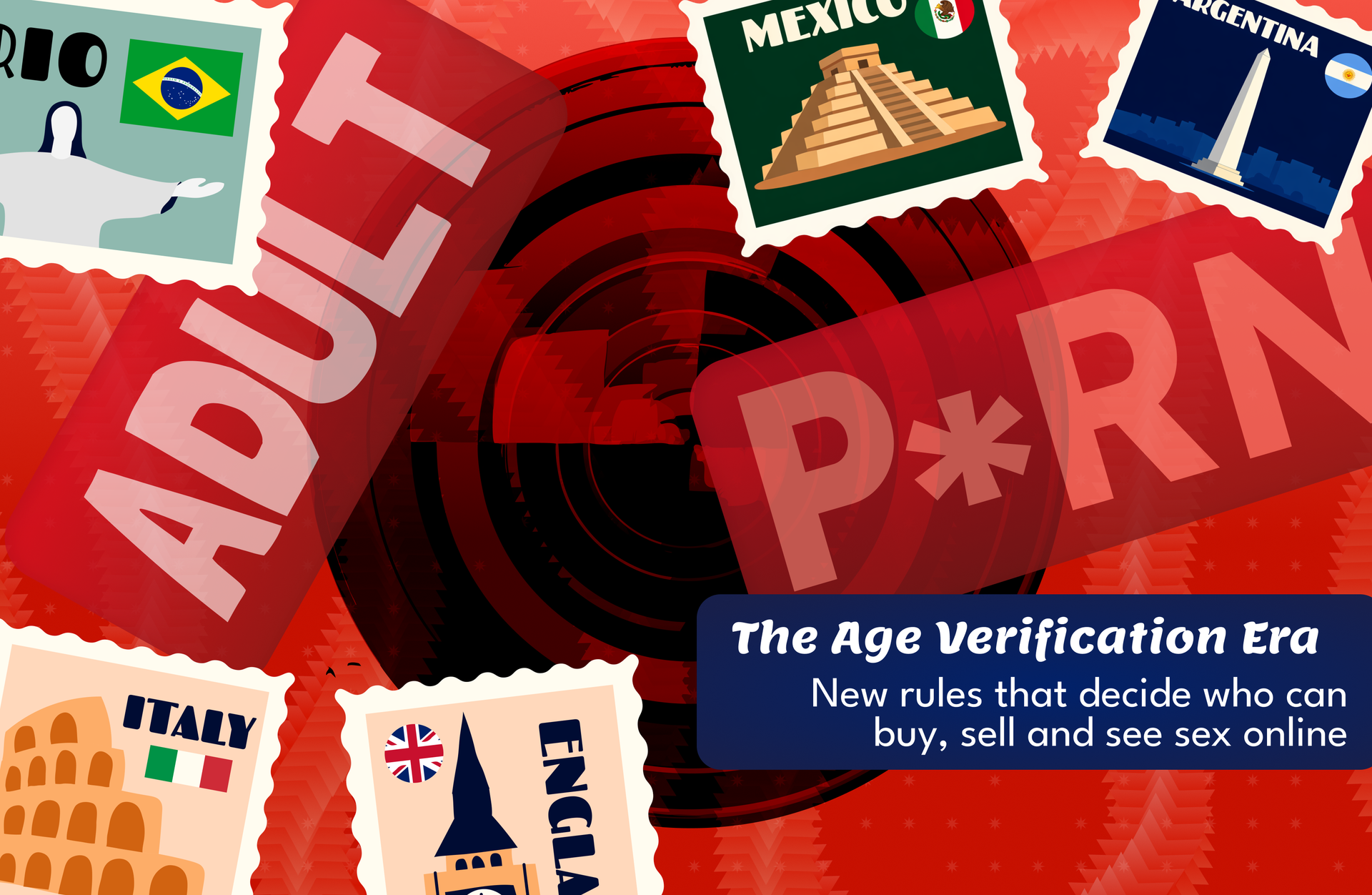
New rules that decide who can buy, sell and see sex online
The era of age verification has officially begun, marking a radical transformation in how adult content is consumed, distributed, and regulated globally.
This report analyzes the rise of a new digital paradigm where anonymity is no longer the default, but a frontier guarded by increasingly sophisticated "age assurance" technologies.
By examining the regulatory frameworks of pioneer nations such as the United Kingdom (Online Safety Act) and Italy (AGCOM Regulations), the reforms in Australia and New Zealand, and the legislative ferment across Latin America -including Argentina, Brazil, Chile, Colombia, Ecuador, Perú, and México - a mosaic of approaches emerges, all attempting to balance the protection of minors with fundamental rights.
However, behind the moral imperative of child protection lies a growing unease: the fear that these technological barriers may morph into tools for social control and marginalization.
For sex workers, these regulations risk translating into forced de-anonymization, threatening their physical safety and economic stability while pushing them toward darker, less secure corners of the web.
For users, the systematic monitoring of sexual habits raises the specter of unprecedented digital surveillance.
There is a concrete risk that age verification is not an end, but a means: a de facto abolition of sex work through bureaucratic asphyxiation and algorithmic stigmatization, eroding the space for self-determination and freedom that the internet has, until now, guaranteed.
South America
Within the South American landscape, 2025 marked a turning point with the passage of landmark laws imposing an unprecedented crackdown on digital content access. In Brazil, the entry into force of Law 15.211 (ECA Digital) in March 2026 introduced a mandate for "reliable" verification methods, definitively moving past ineffective self-certification systems and establishing fines of up to 50 million Reais. Simultaneously, Colombia consolidated its commitment via Ley 2489, joining nations like Chile and Argentina in a coordinated push toward "digital sovereignty" and child protection.
However, this legislative acceleration - unfolding in contexts characterized by sharp socio-economic disparities - raises critical alarms. The requirement to link government-issued IDs or biometric data to access adult platforms risks further marginalizing local sex workers.
In countries where social stigma remains deeply rooted, the creation of centralized databases not only exposes workers to potential leaks and blackmail but also threatens to dismantle the only space - the digital one - that has so far offered a form of protection and independence compared to street-based work, which is far more dangerous and less regulated.
Argentina
 Agustina Iglesias
Brasil
 Ramona Viola
Chile
 Kathy Molina Chacón
Colombia
 Mauricio Luis Amaya
Ecuador
 Mayuri Castro
México
 Frida Mendoza
Perú
 Mar Pérez
Europe
In Europe, the age verification landscape is dominated by a constant tension between child safety and the ironclad privacy protection mandated by the GDPR. While the European Union works toward implementing the EU Digital Identity Wallet (eIDAS 2.0) as an interoperable solution, nations such as the United Kingdom and Italy have moved ahead with decisive national approaches.
In Italy, the AGCOM regulation (Resolution 151/24/CONS) introduced a "double-blind" system designed to prevent websites from knowing the user's identity while simultaneously ensuring that identity providers (such as SPID or CIE) do not know which sites the user is visiting.
However, this seemingly perfect architecture hides deep-seated pitfalls. The centralization of authentication processes creates a digital bottleneck that could be exploited for purposes of moral censorship. The risk is that high technical requirements may force independent platforms and small-scale creators - including European sex workers - to migrate toward large monopolistic hubs or, conversely, toward the dark web, losing legal and banking protections in the process.
In this context, Europe stands at a crossroads: to become the global model for secure and anonymous browsing, or to transform into a fragmented digital ecosystem where access to online sexuality is mediated and surveilled by the State.
UK
 Megan Wallace
Italy
 Franco Trentalance
Oceania
In Oceania, the approach to age verification is characterized by a technological pragmatism that borders on mass biometric surveillance. Australia, led by its eSafety Commissioner, has embarked on a regulatory crusade aimed at making tech giants directly responsible for child protection, threatening million-dollar fines for failing to implement robust "age assurance" systems. New Zealand, while following a similar path, maintains a more open debate regarding the cultural impact of such measures, attempting to balance safety with the freedom of expression typical of its democratic traditions.
However, the true point of friction lies in the adoption of facial scanning and AI-based age estimation technologies. For Australian users and sex workers, this scenario foreshadows a future where accessing digital pleasure or labor literally requires "handing over one's face" to an algorithm.
There is a well-founded fear that Oceania is setting a dangerous precedent: a control infrastructure that could easily be repurposed to monitor other forms of dissent or behaviors deemed "immoral."
Instead of protecting the vulnerable, these rules risk transforming the internet into a hierarchical environment where sexual freedom is a privilege granted only to those who accept the total surrender of anonymity.
Australia
 Ramona Viola
New Zealand
 Ramona Viola
Want more information on Sex Work in your country or worldwide?